Secure Site

Please be assured that your information is protected and secure. We value your privacy and do not provide customer information to any third parties.
A Smarter Way to Complete AHA CPR Skills
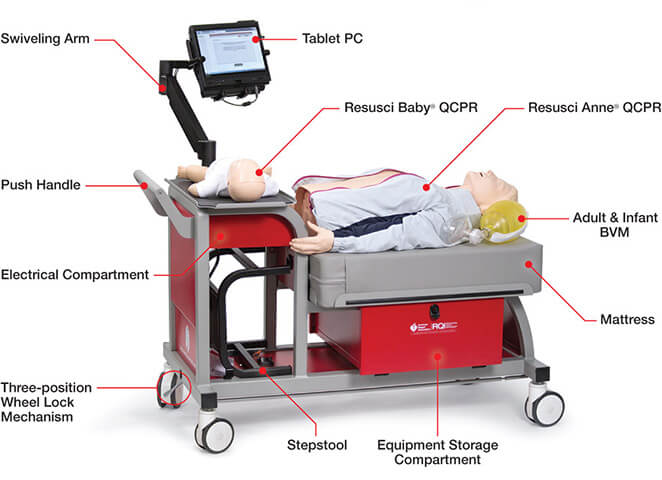
RQI (Resuscitation Quality Improvement) is an American Heart Association–approved training system that allows healthcare professionals to complete their CPR skills verification using advanced simulation technology—without a traditional instructor-led class.
RQI is developed and supported through the American Heart Association in partnership with RQI Partners and Laerdal Medical, the global leader in resuscitation training equipment.
How RQI Works
RQI uses a voice-assisted simulation manikin that guides you step-by-step through the required CPR skills for:
-
BLS (Basic Life Support)
-
ACLS (Advanced Cardiovascular Life Support)
-
PALS (Pediatric Advanced Life Support)
During your skills check, the system:
-
Gives real-time verbal coaching
-
Measures compression depth, rate, recoil, and ventilations
-
Ensures performance meets AHA standards
-
Confirms competency objectively and consistently
Once all skills are completed successfully, your official AHA eCard is issued—often the same day.
What Makes RQI Different From Traditional CPR Classes?
Traditional Instructor-Led Classes
-
Fixed schedules
-
Group settings
-
Instructor-dependent feedback
-
Several hours long
-
Cards may take days to be issued
RQI Skills Check Appointments
-
On-demand scheduling
-
One learner at a time
-
Standardized, objective feedback
-
Typically completed in 30–45 minutes
-
Immediate or same-day AHA eCard
RQI removes variability and focuses on actual skill performance, not lecture time.
Is RQI AHA-Compliant?
Yes.
RQI is fully American Heart Association–approved and accepted by:
-
Hospitals
-
Clinics
-
Dental practices
-
EMS agencies
-
Universities
-
Credentialing and compliance departments
Your certification card is the same official AHA eCard issued for instructor-led courses.
Do I Need an Instructor?
No instructor lecture is required.
RQI is:
-
Self-guided
-
Voice-assisted
-
Performance-based
A staff member may be available on-site for check-in or technical assistance, but the skills evaluation itself is completed independently using the simulation station.
Who Is RQI Best For?
RQI is ideal for:
-
Healthcare professionals renewing BLS, ACLS, or PALS
-
Busy clinicians who need flexible scheduling
-
Students who prefer self-paced, focused skills testing
-
Employers seeking standardized, compliant CPR verification
What Do I Need Before My RQI Skills Check?
You must:
-
Complete the AHA HeartCode online portion (BLS, ACLS, or PALS)
-
Bring or upload proof of online completion
-
Arrive on time for your scheduled appointment
Plan for 30–45 minutes per skills check.
Why We Use RQI
We use RQI because it:
-
Ensures consistent AHA-compliant skills verification
-
Reduces scheduling barriers
-
Eliminates instructor variability
-
Provides immediate, objective feedback
-
Allows learners to train on their schedule
RQI represents the future of CPR education—focused on performance, precision, and accessibility.